
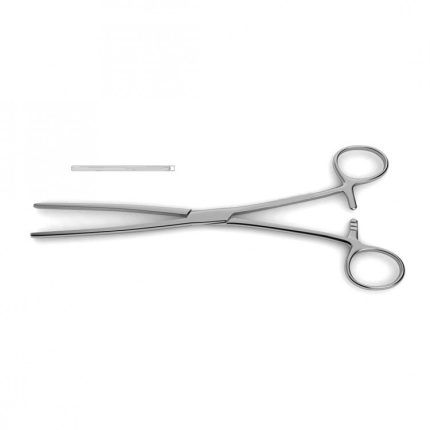
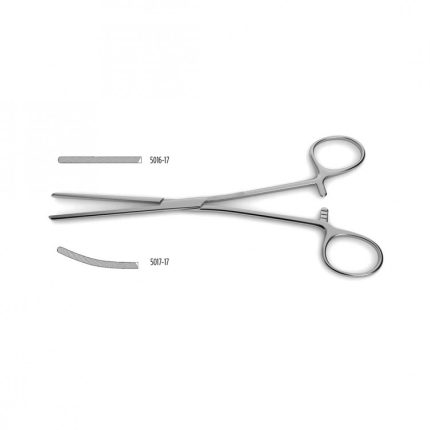
| Name | Doyen-Baby Intestinal Forceps – Atraumatic Serrations |
| Lead Time | Lead time advised within 48 hours of order placement. |
| Specialty | General Instruments-Ring-Handled Forceps – Intestinal |
| Material Finish | Stainless Steel |
| Grade | Premium Operating Room |
| Units of Measurement | Each |
| Manufacturer | AGO INDUSTRY |
| Sterility | Non-Sterile |
| Usage | Reusable |

Doyen-Baby Intestinal Forceps – Atraumatic Serrations
jaws w/ atraumatic serrations.
Doyen-Baby Intestinal Forceps are specifically designed with long jaws with atraumatic serrations. These types of serrations can block a part of the intestines without crushing or traumatizing the area. The forceps are offered in a straight or curved pattern with the choice of a 5″ or 6 ¾” length.
Description
Reviews (0)
Shipping & Delivery
Related products

Artery & Intestinal Forceps
Longitudinal serrations, 1x2 teeth, straight
Allen-Kocher Artery and Intestinal Forceps are designed with longitudinal serrations on straight jaws. These ratchet ring-handled forceps also contain 1x2 teeth on the tips of the jaws that interlock in order to compress tissue in which blood is being depleted.

Babcock Intestinal Forceps
Jaws w/ atraumatic parallel serrations
Babcock Intestinal Forceps have jaws with atraumatic parallel serrations that are intended to hold a shorter section of intestine with minimal trauma and constriction. There is a ratchet on the inner side of the ring-handles so that the forceps can lock in place when needed during a surgical procedure. The forceps are polished to a dull, satin finish to minimize glare below operating room lights.

Allis Tissue Forceps – Atraumatic Jaws
Jaws w/ atraumatic parallel serrations
Allis Tissue Forceps contain jaws with atraumatic parallel serrations. These types of serrations are designed to eliminate damage caused to the tissue when trying to grasp or hold it during surgery. The adjustable ratchet ring-handle provides the forceps to be held in a locked position. This instrument is also presented with narrow or standard jaws with an option of 6" or 8" length.

Adson Artery Forceps
Adson Artery Forceps
Adson Artery Forceps can be used as a hemostat for general surgeries to regulate bleeding of broken arteries in the course of an operation. These forceps are developed with ring-handles and a locking ratchet to ensure a firm grasp on the artery. They are also offered in a delicate or standard pattern with the choice of curved or straight jaws.
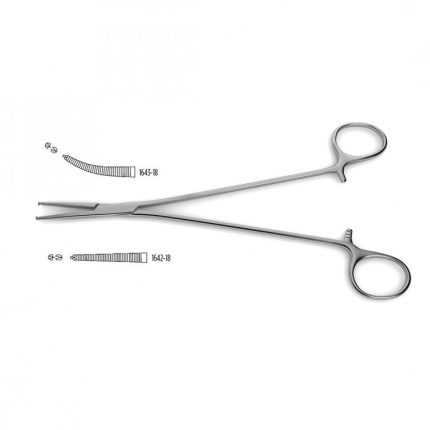
Adson Artery Forceps – Delicate
Delicate pattern, 1x2 teeth, 7-1/8" (18.0 cm)
Adson Artery Forceps are 7 1/8" and are developed with 1x2 teeth in a delicate pattern with either curved or straight jaws to suit different needs. Primarily applied during operations in which arteries need to be grasped or compressed, the teeth on the tips of the jaws interlock to confirm that a tight grip is held.

Babcock Tissue Forceps
Babcock Tissue Forceps
standard pattern.
Babcock Tissue Forceps come in a standard pattern with semicircular rounded tips to allow for holding or grasping delicate body structures. These forceps are crafted from premium German operating-room grade stainless steel and are available in a wide variety of lengths.

Adson Thumb Forceps – Angled Tips
Adson Thumb Forceps - Angled Tips
angled tips, 4-3/4" (12.1 cm)
Adson Thumb Forceps are handcrafted from surgical grade German stainless steel with angled tips. Available in a variety of forms: for dressings with a serrated platform or for tissue with a serrated platform and 1x2 teeth or 1x2 teeth with cross-serrated tips.
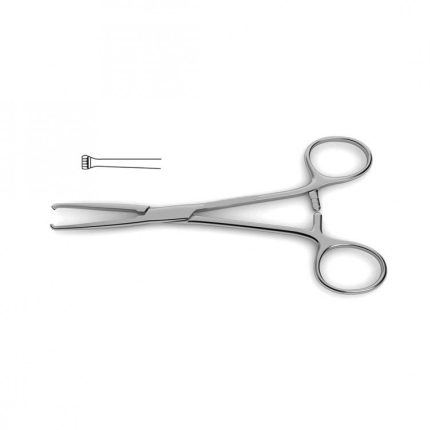
Allis Tissue Forcep
Allis Tissue Forceps
standard pattern
standard pattern of the Allis Tissue Forceps are intended for the use of firmly grabbing or holding body tissue during surgery. This pattern includes a ratchet ring-handle with a selection of different sizes and types of teeth to accommodate various medical procedures. These teeth curve to the inside and may cause less harm to the tissue because of decreased general pressure applied to the area.

Reviews
There are no reviews yet.